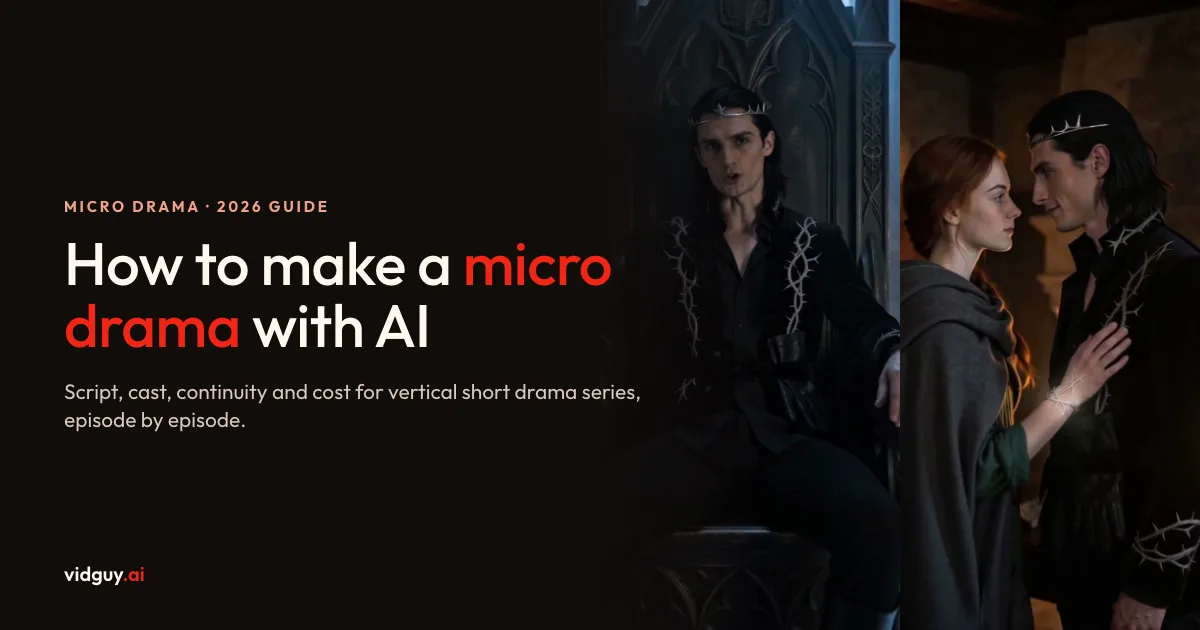
A micro drama is a vertical TV series cut into episodes of one to two minutes, made to be watched on a phone. Each episode ends on a cliffhanger, and a full season runs to dozens of parts. You can now make one with AI from a script or a one-line idea. The two things that decide whether it looks like a series or a pile of clips are the script structure and character continuity.
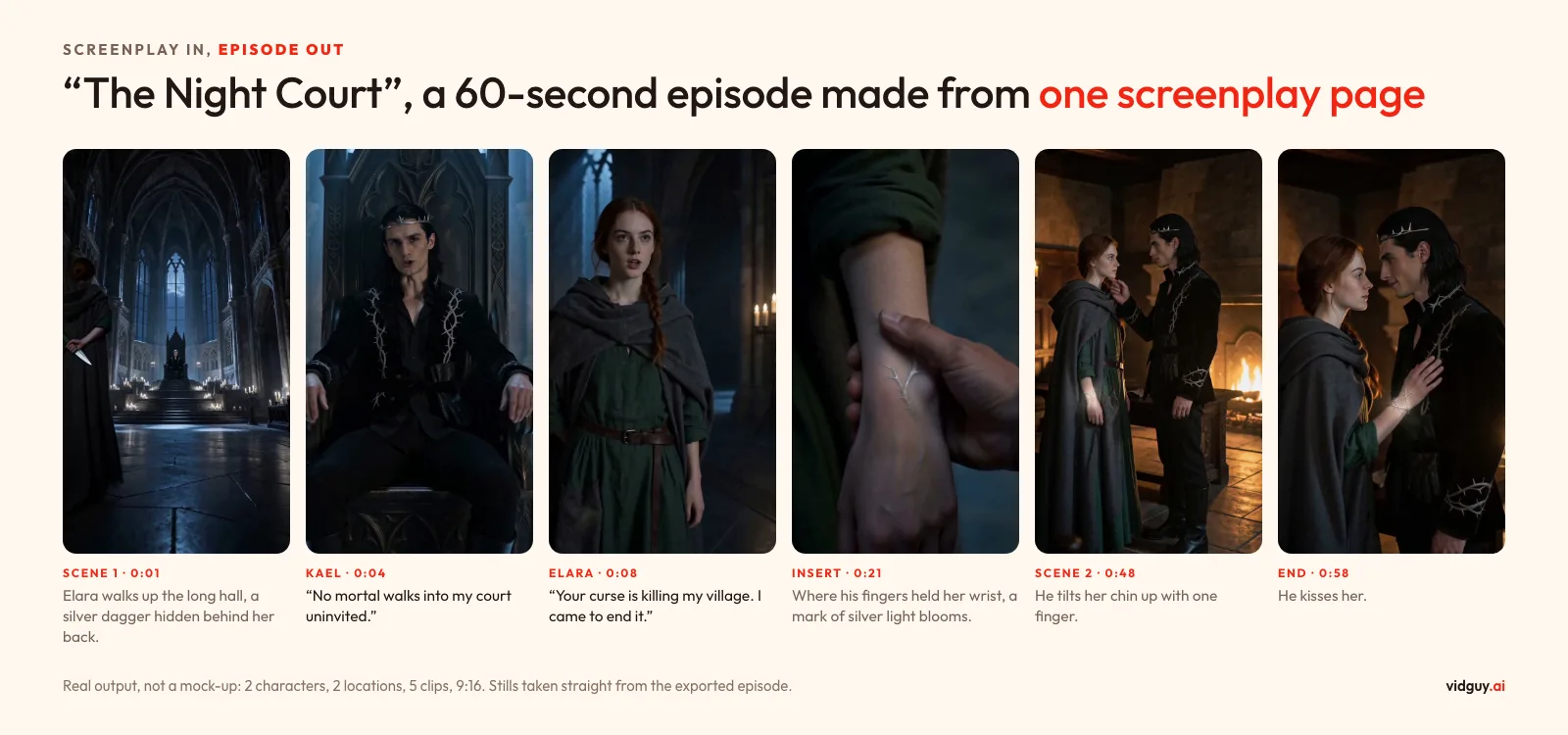
This guide covers what micro dramas are, why the format is growing so fast, how to write an episode that holds people, and how to keep the same cast across every clip and every episode. We use a real 60-second episode made in VidGuy as the worked example throughout.
Key takeaways
- A micro drama episode runs about 60 to 120 seconds, is shot 9:16, and ends on a hook that sells the next episode.
- The market is large and still growing: Omdia puts global micro drama revenue at about $11 billion in 2025, heading for $14 billion in 2026.
- With AI, the hard part is no longer making a clip. The hard part is keeping faces, wardrobe, props and voices identical from clip to clip and episode to episode.
- The fix is a cast bible: reference pictures approved once and fed into every generation.
- Our first live episode, 60 seconds with two characters and two locations, cost 82 credits on VidGuy's budget route and took 13 minutes from start to export.
What is a micro drama?
A micro drama (also called a short drama, vertical drama or, in China, duanju) is a scripted series made for phones. Episodes are short, usually one to two minutes. The frame is vertical. The plots move fast: a betrayal, a secret identity, a forbidden romance, a revenge arc, with a reversal every minute and a cliffhanger at the end of each episode.
Viewers usually find them on dedicated apps such as ReelShort and DramaBox, or as series on TikTok, Instagram Reels and YouTube Shorts. On the apps, the first few episodes are free and the rest are unlocked with coins or a weekly pass, which is why every episode has to end on a moment the viewer will pay to resolve.
| Micro drama | Web series | TikTok skit | |
|---|---|---|---|
| Episode length | 1–2 min | 5–20 min | 15–60 s |
| Episodes per season | Dozens, often 60–100 | 6–12 | One-offs |
| Frame | Vertical 9:16 | Usually 16:9 | Vertical 9:16 |
| Ends on | A cliffhanger, every time | A scene | A punchline |
| How it earns | Paid unlocks, ads, licensing | Ads, sponsors | Creator fund, brand deals |
Why are micro dramas growing so fast?
Because people watch them for longer than they watch streaming apps, on the device they already hold. A few numbers, each with its source:
- Market size. Omdia estimates global micro drama revenue at about $11 billion in 2025 and about $14 billion by the end of 2026, with roughly $3 billion of that from outside China (IBC, February 2026). Deloitte's narrower estimate, in-app revenue only, is $7.8 billion in 2026, up from $3.8 billion (Deloitte TMT Predictions).
- Time spent. In Q4 2025, US users spent 35.7 minutes a day in ReelShort, against 24.8 in Netflix and 26.9 in Prime Video on mobile, according to Sensor Tower data cited by Omdia (IBC).
- Downloads. Short drama apps passed 850 million downloads in Q1 2026, up 140% year on year, with about $750 million in in-app revenue (Sensor Tower).
- AI production. Chinese state broadcaster CGTN reports that 430,000 micro dramas were released in China between January and August 2026, and that more than 90% of them were made with AI (CGTN, September 2026).
That last figure is the important one for anyone outside the big studios. A format that used to need a cast, a crew and a location for every episode can now be made by one writer.
How do you structure a micro drama episode?
Every episode has the same job: hook the viewer in the first seconds, turn the situation once, and stop at the worst possible moment. A 60-second episode has room for four beats.
| Beat | Time | What happens | In "The Night Court" |
|---|---|---|---|
| Cold open | 0–3 s | Drop the viewer into a conflict already in motion | A woman walks up to a throne with a dagger behind her back |
| Stakes | 3–20 s | Say what each character wants and what it costs | "Your curse is killing my village. I came to end it." |
| Turn | 20–45 s | One reversal that changes the situation | He takes the dagger, a mark appears on her wrist: she is bound to him |
| Cliffhanger | 45–60 s | End on a question the viewer needs answered | "Six nights. Not seven." He kisses her. Cut. |
A few rules that hold across the genre:
- No slow starts. Skip establishing shots and get to the conflict. The opening frame should already contain tension.
- One reversal per episode. More than one and nothing lands. None, and there is no reason to watch the next one.
- End mid-beat. Cut on the question, never on the answer. The answer opens the next episode.
- Open with a recap. From episode 2 on, the first two or three seconds should replay the previous cliffhanger, so a viewer who lands mid-series is not lost.
- Write in spoken lines. Short, sharp dialogue reads better on a small screen and is easier for AI video models to lip-sync.
How to make a micro drama with AI, step by step
Here is how the episode in this guide was made with VidGuy's Short Drama workflow, which runs inside the VidGuy chat. Whatever tool you use, the same steps apply.
1. Start from a screenplay or an idea
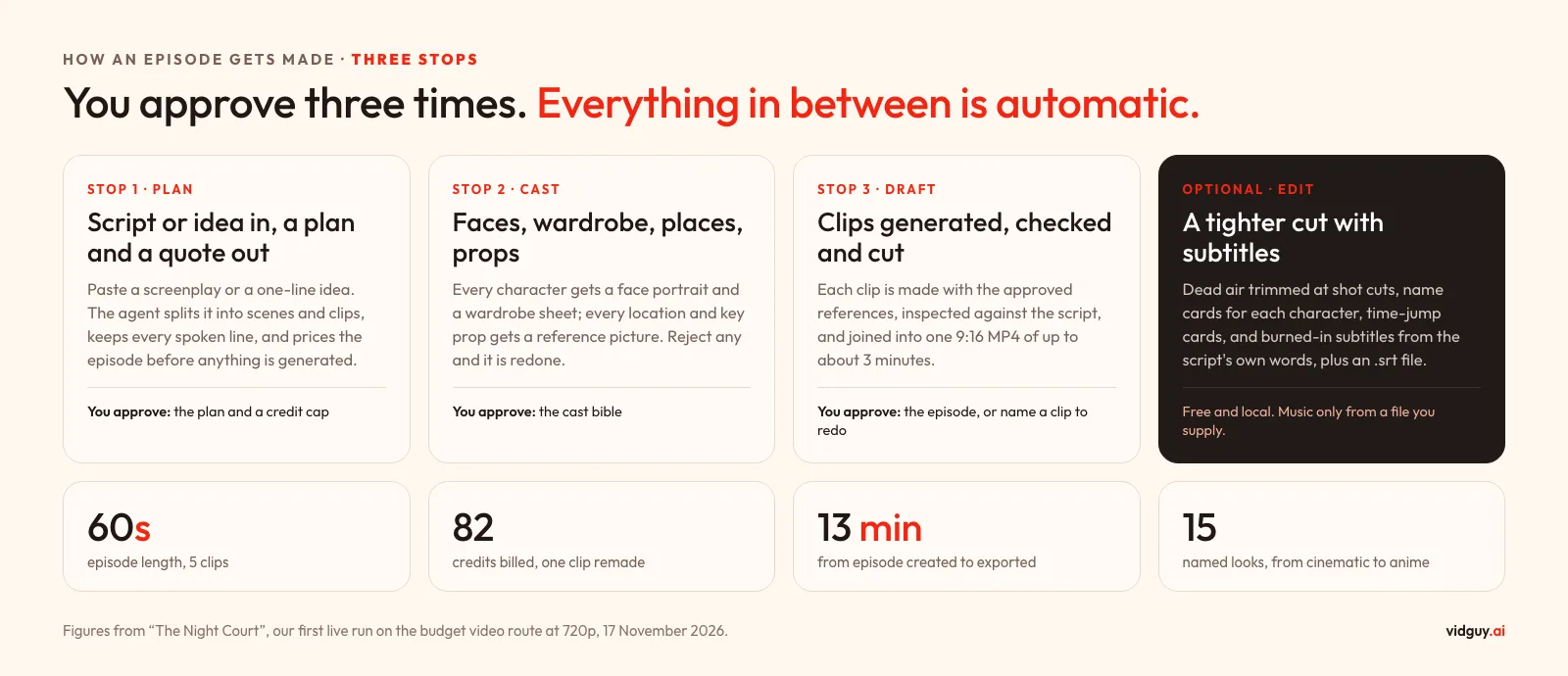
Paste a screenplay, or describe the story in a sentence. With a screenplay, every spoken line, speaker and stage direction is kept word for word unless you ask for an adaptation. A line is never dropped to save time. If the story is too long for one episode, the workflow proposes where to split it instead.
The source for "The Night Court" was one page: two scenes, two characters, nine lines of dialogue.
2. Approve the plan and the price
The agent breaks the script into scenes and clips, stages every scene (who stands where, who holds the dagger, when the mark appears) and prices the whole episode before anything is generated. You approve the plan and set a credit cap. Nothing is spent past it.
3. Build the cast bible
This is the step most AI video tools skip, and the reason so many AI series fall apart by the second clip.
Every character gets a face portrait and a wardrobe sheet: front, three-quarter and profile in the outfit they wear in the episode. Every location and every important prop gets a reference picture too. You look at each one and reject anything that is wrong. Rejected pictures are remade.
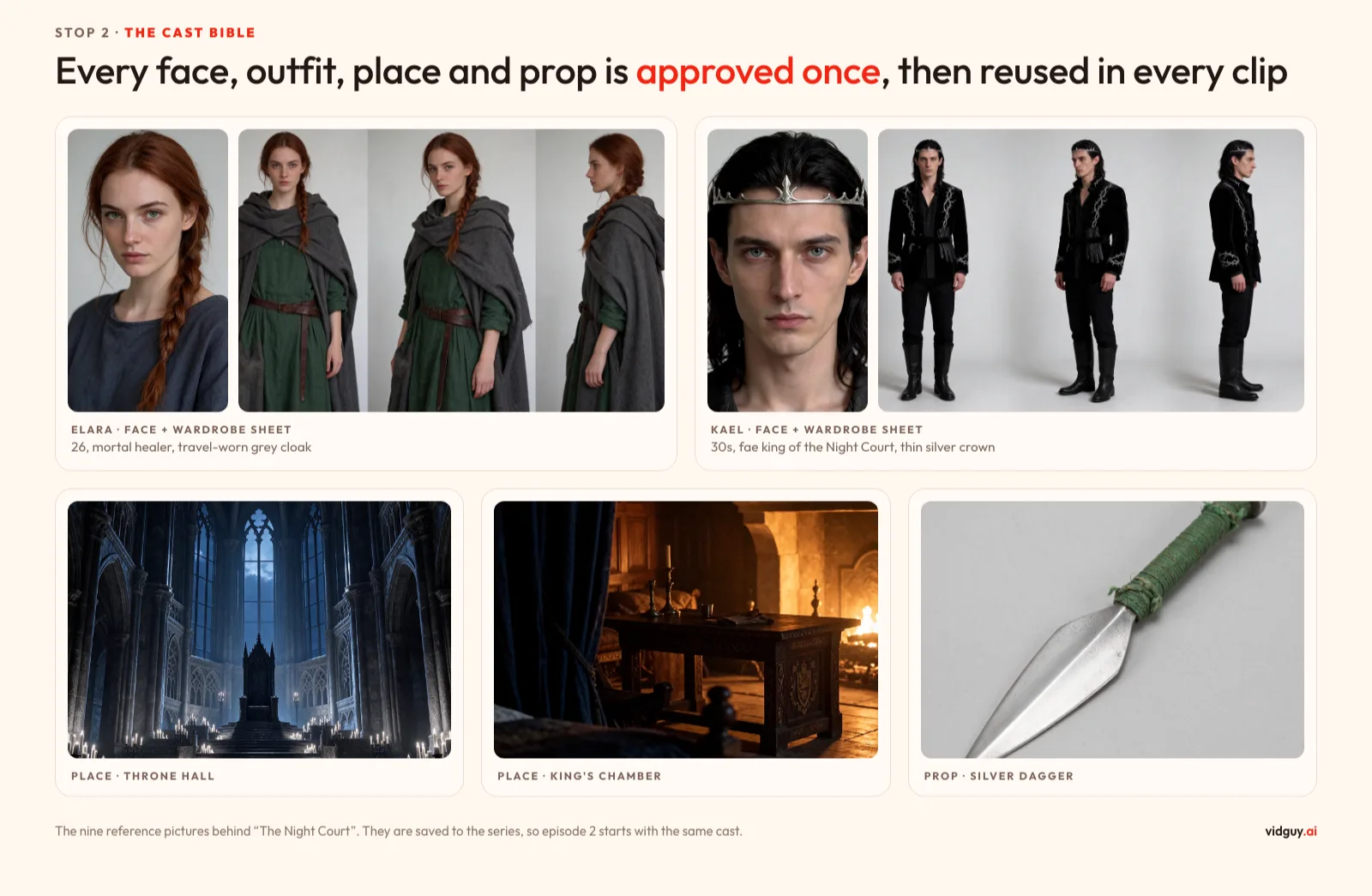
Once approved, these pictures belong to the series, not the episode. Episode 2 starts with the same cast, the same wardrobe and the same rooms.
4. Generate, check and assemble the clips
Each clip is generated with the approved references attached, so the model sees the same face, outfit and room every time. Then each take is checked against the script: length, framing and what the frames show. A clip with a real fault is rejected and remade. In our run, one of the five clips was remade once.
The kept clips are joined into one vertical MP4 of up to about three minutes.
5. Review the draft and fix by clip number
You get a playable episode and a list of numbered clips. To change something, name the clip and what to change ("clip 4, she should step back before she answers"). Only that clip is remade.
6. Optional: a tighter edit with subtitles
A second pass trims dead air at shot cuts, adds name cards for each character and cards for time jumps ("Later"), and burns in subtitles taken from the script's own words, with an .srt file beside the video. Music is laid in only from a file you supply.
How do you keep characters consistent across a micro drama series?
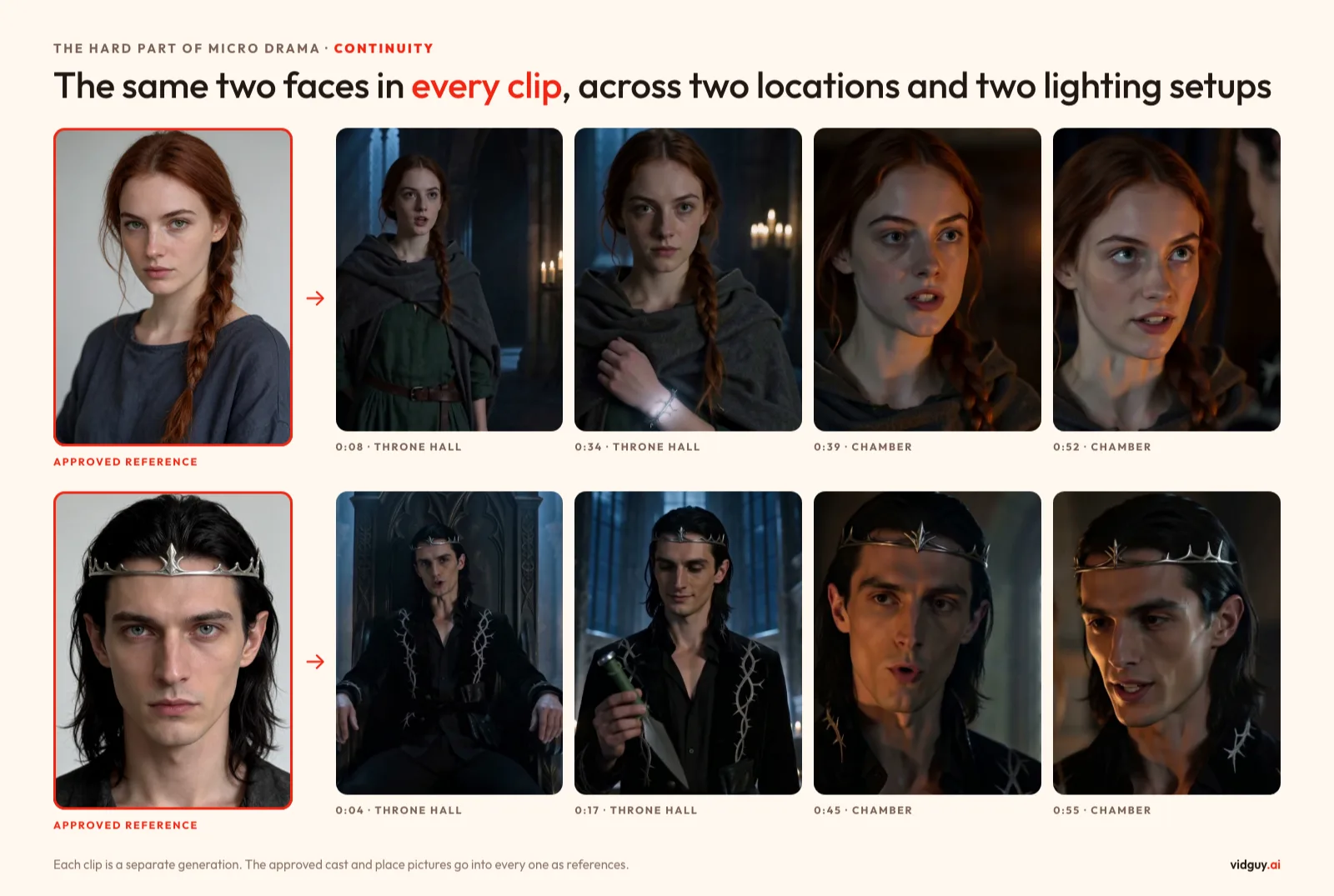
Continuity is the problem that separates a series from a montage. Viewers will forgive a modest budget. They will not forgive a lead whose face changes between scenes, and they are quick to point it out in the comments.
What keeps a cast consistent:
- Lock references before any clip. Approve faces, wardrobe sheets, places and props first. Never let a video model invent a character on the fly.
- Feed the same references into every clip. Each clip is a separate generation. Consistency comes from giving every one of them the same pictures, not from hoping the model remembers.
- Track what changes. If a character is wounded in scene one, picks up a dagger or gets a glowing mark on her wrist, that state has to carry into every later shot. Keep a running list of who is holding what and what has changed.
- One look per series. Pick a visual style (cinematic, anime, 1990s, dark academia, 3D) and keep it for the whole season. VidGuy has 15 named looks to choose from, set once per series.
- Keep voices fixed. A voice described only in words can drift between clips. A short voice sample, 5 to 30 seconds of a voice you own or have consent to use, holds it steady across the series.
- Look at every take. Probes can tell you a clip's length and resolution. Only looking tells you whether the right person said the right line.
How much does it cost to make an AI micro drama?
It depends on length, how many clips each episode needs, the video model and how many takes you throw away. Here is one real episode, not an estimate:
| "The Night Court" | |
|---|---|
| Length | 60 seconds, 9:16, 720p |
| Cast and places | 2 characters, 2 locations, 1 prop |
| Clips | 5 (one remade once) |
| Reference pictures | 10 generated, 22 credits |
| Video clips | 6 generated, 60 credits |
| Total | 82 credits |
| Time, start to export | 13 minutes |
That episode used the budget video route, which suits stylised and animated looks and is weaker on realistic live action. The standard route, built for realistic live action, costs more per second. Every episode is quoted before any credits are spent, so you see the price before you commit.
For scale: VidGuy's Starter plan includes 300 credits a month, and Pro includes 1,000. Credits, not shooting days, are what limits how many episodes you can make.
Where should you publish micro dramas?
- TikTok, Reels and Shorts. Post each episode as its own video and group them with the platform's series or playlist feature. Pin Part 1 to your profile. Put "Part 3" in the first frame and in the caption, so a viewer who arrives mid-series knows where to start.
- Keep a steady schedule. A series builds an audience when the next episode arrives when people expect it. Making several episodes ahead lets you post daily.
- Cut extra clips from each episode. The cliffhanger and the reversal each work as a standalone teaser that points back to the full episode.
- Label AI content. TikTok and YouTube both ask creators to disclose realistic AI-generated video. Turn the label on when you upload.
If you want to put a product inside the story rather than run a series, that is a different format. See our guide to micro drama ads.
Frequently asked questions
What is a micro drama?
A micro drama is a scripted vertical series made for phones. Each episode runs about one to two minutes and ends on a cliffhanger, and a season usually has dozens of episodes. They are watched on apps such as ReelShort and DramaBox and as series on TikTok, Reels and YouTube Shorts.
How long is a micro drama episode?
Most episodes run 60 to 120 seconds. Deloitte describes the format as hundreds of 60-to-90-second serialized episodes. VidGuy's Short Drama workflow makes episodes of up to about three minutes; the example in this guide runs 60 seconds.
How many episodes does a micro drama have?
Seasons on the big apps often run 60 to 100 episodes. The first few are free and the rest are paid, so each early episode is written to make the viewer unlock the next one. A creator series on TikTok can be much shorter: 5 to 20 episodes is a reasonable first season.
Can AI make a micro drama?
Yes. AI can now write, cast, shoot and cut a full episode from a screenplay or an idea. CGTN reports that more than 90% of the micro dramas released in China in early 2026 were made with AI. The weak point is continuity, which is solved by approving character, wardrobe and location references before generating any clip.
How do you keep the same characters across AI video clips?
Approve a face portrait and a wardrobe sheet for each character before generating anything, then attach those same pictures to every clip. Save them to the series so later episodes reuse them. A short voice sample keeps each character's voice consistent in the same way.
How much does it cost to make a micro drama with AI?
A 60-second, two-character episode with five clips cost 82 credits on VidGuy's budget route, including one remade clip. Realistic live action on the standard route costs more per second. Every episode is quoted before anything is spent.
Can I turn my own screenplay into a micro drama?
Yes. Paste the screenplay and every spoken line and speaker is kept word for word unless you ask for an adaptation. If the script is too long for one episode, the workflow proposes where to split it into episodes rather than cutting lines.
What is the difference between a micro drama and a short drama?
There is no real difference. Micro drama, short drama, vertical drama and duanju all describe the same format: short, vertical, serialized episodes that end on cliffhangers.
Try it
Write one page. Two characters, one conflict, one reversal, one cliffhanger. Then start a chat in VidGuy, type /short-drama and paste it in. You will see the plan and the price before anything is generated.